45,000 Spouses and Children in Canada Get Permanent Residence Space in 2027
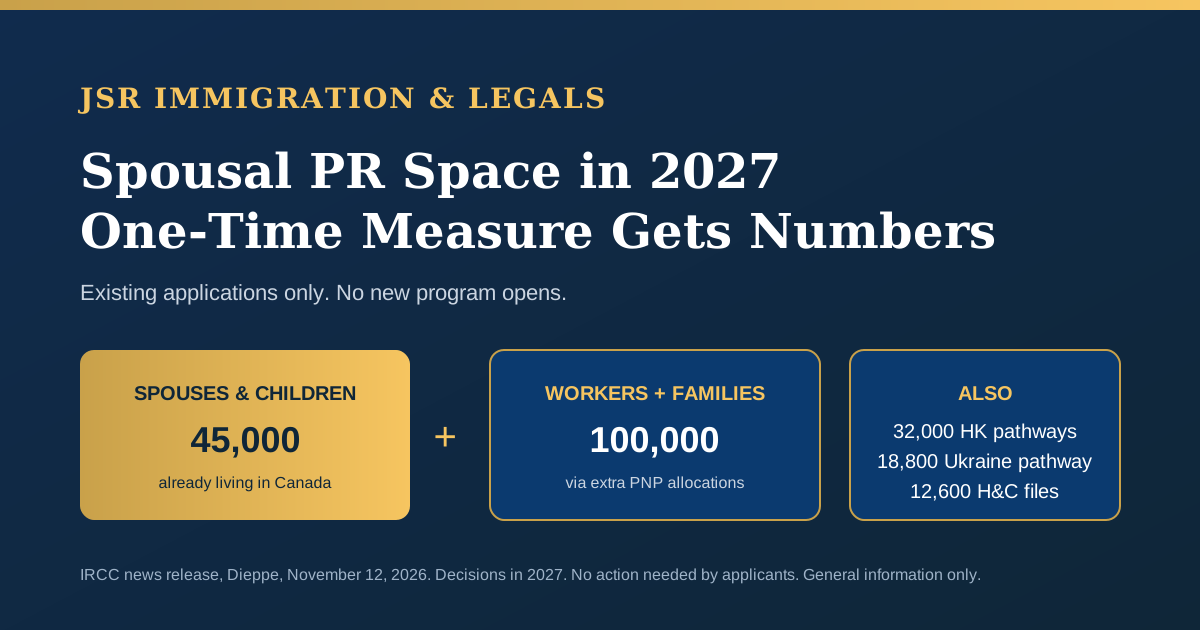
On November 12, 2026, in Dieppe, New Brunswick, Immigration Minister Lena Metlege Diab filled in the biggest gap in Budget 2026's one-time permanent residence measure: the numbers. In an official IRCC news release dated November 12, 2026, the department states it will also help transition to permanent residence up to 45,000 spouses, common-law partners and dependent children of Canadian citizens or permanent residents living in Canada.
That is the first hard figure attached to the family piece of the measure. When we explained the overall 200,000-person plan on November 9, IRCC had confirmed the cohorts but not their sizes. It has now.
The numbers IRCC published
The release attaches a ceiling to each stream of the time-limited measure.
| Group | Additional space |
|---|---|
| Workers nominated by provinces and territories, with their families | Up to 100,000 combined |
| Spouses, common-law partners and dependent children in Canada | Up to 45,000 |
| Hong Kong permanent residence pathways (closed August 2026) | Up to 32,000 |
| Ukraine Family Reunification Pathway (closed October 2024) | Up to 18,800 |
| People already found eligible on humanitarian and compassionate grounds | Up to 12,600 |
The workers stream works through extra Provincial Nominee Program allocations. Provinces and territories can use that optional additional space, by March 31, 2027, to nominate workers already established in their communities. They can also identify workers who have already applied under the Atlantic Immigration Program or under federal programs closed to new applications, including the Start-up Visa Program, the Self-Employed Persons Program, the Agri-Food Pilot and the home care worker programs.
What the 45,000 means for families
The 45,000 is not a new program and not a new application route. IRCC says it plainly: these measures do not create new programs or re-open closed pathways. The space exists to finalize applications that are already in the inventory in 2027.
Three practical points follow.
- Applicants do not need to do anything. IRCC states that applicants do not need to contact the department for their applications to be processed under the additional spaces.
- The person must already be living in Canada. The stream targets spouses, partners and dependent children of Canadians and permanent residents who are in Canada, with a permanent residence application already on file.
- The announcement date is not the admission date. Nothing opened on November 12. The admissions space is for 2027 decisions.
The November 5 Budget backgrounder also repeated the government's processing goal of bringing spousal and common-law partner wait times closer to 12 months for files destined to provinces and territories outside Quebec. That is a goal for files already in processing, not a promise for applications filed later.
What this measure is not
The release is explicit that this measure is separate from the In-Canada Worker Initiative announced in Budget 2025. It also does not re-open the Hong Kong pathways, which closed to new applications in August 2026, or the Ukraine Family Reunification Pathway, which closed in October 2024. If someone offers to sell you access to the 45,000 spousal space or a 2027 guarantee, that offer is not real.
The figure is planning space, not an entitlement. Reaching the ceiling depends on how many eligible files are actually in the inventory and how fast they can be finalized.
What to do now
If you are a spouse, partner or dependent child of a Canadian citizen or permanent resident, you are living in Canada, and your permanent residence application is already filed, the practical step is to keep your file current: respond to IRCC requests quickly, keep your address and documents up to date, and do not let medicals or police certificates lapse. No separate application to this measure exists.
If you are married or in a common-law relationship and have not yet applied, this measure does not cover you. You still apply through the regular spousal sponsorship process, and processing times depend on when you file. See our spousal sponsorship page for how those files work, our permanent residence page for the broader pathways, and our PNP page if your situation also involves a worker stream nomination.
To review where an existing family or worker application sits after the November 12 announcement, contact JSR Immigration & Legals through our consultation page.
This article is general information current to November 17, 2026, and is not legal or immigration advice. IRCC had not published eligibility criteria beyond the November 12, 2026 news release when this was written. Confirm the live release and program pages on Canada.ca before you act.

Immigration & paralegal practitioner at JSR Immigration & Legals, helping newcomers and Ontario residents with their cases.
This post is general information about Canadian immigration and Ontario paralegal matters and is not legal advice. Rules change and every case is different — confirm current requirements for your own situation.