PAL and TAL Letters Explained: The 2026 Study Permit Cap and the Letter You May Need
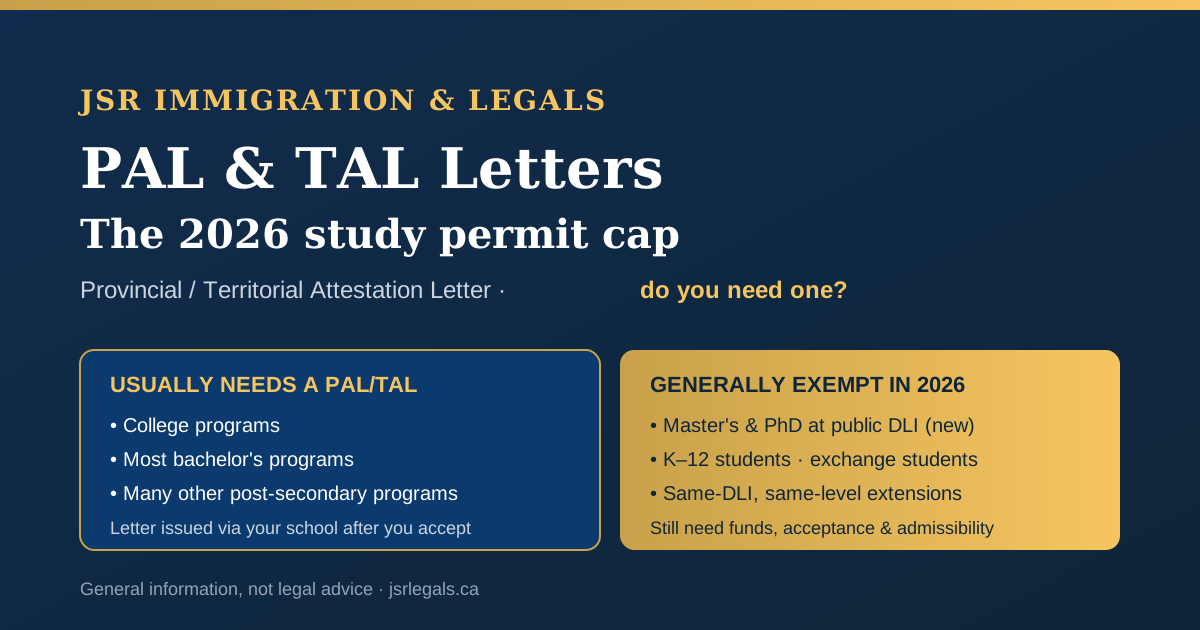
If you're planning to study in Canada, you've probably run into a four-letter acronym that wasn't part of the process a couple of years ago: the PAL — a Provincial Attestation Letter (or TAL, a Territorial Attestation Letter, in Yukon, the Northwest Territories and Nunavut). For many applicants, no PAL means no study permit. For others — including a large group as of 2026 — it's no longer required at all.
Here's a plain-language guide to what these letters are, who needs one this year, and how the pieces fit together.
Why PALs exist
Since early 2024, Canada has run a national cap on new study permit applications. The cap is divided into allocations for each province and territory, and each one decides how to share its slice among its designated learning institutions (DLIs). The PAL/TAL is the document that proves your application counts against a real, available spot in that province's allocation.
The federal government sets a target number of approved study permits for the year and releases a larger number of application "spaces" to account for refusals and withdrawals. The exact figures change annually, so always confirm the current year's numbers on the official IRCC page rather than relying on a headline. The takeaway for applicants is simpler: spaces are limited, and the PAL is how you claim one.
Who needs a PAL/TAL in 2026 — and who doesn't
This is where 2026 brought a meaningful change. As of January 1, 2026, master's and doctoral students at a public DLI no longer need a PAL/TAL. That's a notable shift, because graduate students were previously pulled into the requirement.
In general terms for 2026:
- You usually still need a PAL/TAL if you're applying for college programs,
most undergraduate (bachelor's) programs, and many non-degree programs at the post-secondary level.
- **You generally do not need a PAL/TAL** if you fall into an exempt group,
which currently includes:
- Master's and doctoral students at a public DLI (new for 2026);
- Primary and secondary (K–12) students;
- Exchange students coming to a Canadian DLI;
- People extending an existing study permit at the **same DLI and the same
level** of study;
- Certain Government of Canada priority and vulnerable groups.
Even where a PAL is no longer mandatory, a few provinces may still issue or request an attestation letter for their own tracking. If your school sends you one, keep it — it doesn't hurt your application.
How you actually get one
A common misunderstanding is that you apply to IRCC for a PAL. You don't. The province or territory issues it, almost always through your school, and only after you've accepted your offer. The usual sequence looks like this:
- Receive and accept your letter of acceptance from a DLI.
- Pay the required deposit (often a tuition deposit) the school asks for.
- The school requests the PAL/TAL from the provincial/territorial government
on your behalf, or the province issues it directly.
- You receive the letter — timelines vary by institution and province, from
a few business days to longer during peak periods.
- You upload the PAL/TAL with your study permit application.
Because PALs are tied to the annual cap, a letter issued in 2026 is generally valid only through the end of 2026 for that cap year. Don't sit on it — apply for your study permit while it's valid.
What happens if you skip it
If your category requires a PAL/TAL and you apply without one, IRCC will typically return your application as incomplete — you don't get a refusal on the merits, but you lose time, and in a capped system time matters. The fix is to make sure the letter is in hand before you submit, and to double-check that your letter of acceptance clearly states your program level (for example, "master's" or "doctorate"), so an exempt application isn't mistakenly returned.
A few practical reminders
- The PAL/TAL is one document among several. You still need a valid letter of
acceptance, proof of funds, and to meet all other study permit and admissibility requirements.
- Rules, allocations and exemption lists change from year to year. What was
true in 2024 or 2025 isn't necessarily true now.
- When in doubt, confirm against the official IRCC page on attestation
letters and the current provincial/territorial allocations notice, and ask your school's international student office.
Get in touch
Study permit rules have moved quickly over the past two years, and the PAL/TAL layer adds a step that's easy to get wrong. If you're unsure whether you need an attestation letter, when to apply, or how the 2026 changes affect your plans, the team at JSR Immigration & Legals is happy to help you sort out your next steps.
This article is general information about Canadian immigration and is current as of its publication date — it is not legal advice for your specific situation. Confirm current requirements with official sources or a licensed professional before you act.

Immigration & paralegal practitioner at JSR Immigration & Legals, helping newcomers and Ontario residents with their cases.
This post is general information about Canadian immigration and Ontario paralegal matters and is not legal advice. Rules change and every case is different — confirm current requirements for your own situation.