Toronto's 2026 Vacant Home Tax Declaration Is Open: Deadline April 30, 2027
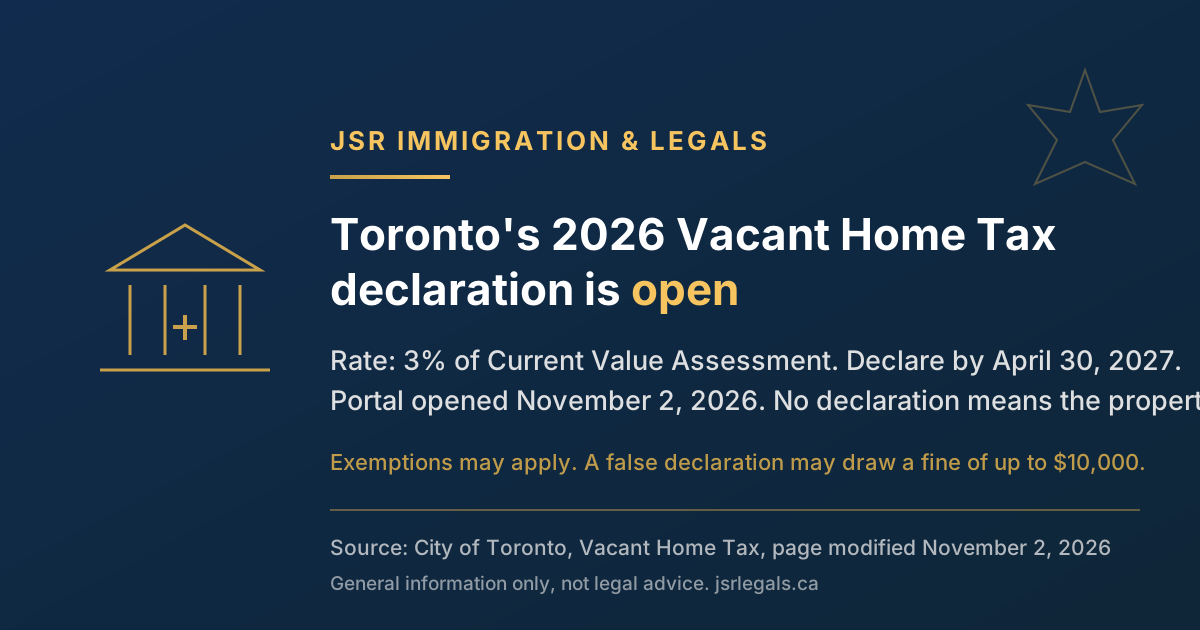
Toronto residential property owners have a new annual task on their plates. On November 2, 2026, the City of Toronto opened the online portal for 2026 Vacant Home Tax declarations, and every residential property owner must file one for the 2026 occupancy period, January 1 to December 31, 2026, even if the property is their principal residence. An owner who does not submit a declaration may have the property deemed vacant, with the tax applied. The deadline to declare is April 30, 2027. Here is what the program requires, what it may cost, and what owners, buyers and sellers should check before the deadline.
What the Vacant Home Tax is
The Vacant Home Tax (VHT) is a municipal tax the City of Toronto applies to residential properties that are vacant for six months or more in a calendar year. The City's stated goal is to increase housing supply by encouraging owners of empty homes to sell them or rent them out, and revenue from the tax is allocated to affordable housing initiatives. The program operates under the City of Toronto Act, 2006 and Toronto Municipal Code Chapter 778.
For the 2026 taxation year, the VHT is set at three per cent of the property's Current Value Assessment (CVA), as determined by the Municipal Property Assessment Corporation. The rate has been three per cent since 2024. On a property assessed at $1,000,000, the tax on a vacant year is $30,000. The assessment may differ from market value, but it is the base the City uses.
How to declare
To complete a declaration, an owner needs their customer number and the property address or 21-digit assessment roll number, all found on the property tax bill. Declarations may be submitted three ways:
- Online through the City's declaration portal. Owners who file online receive a confirmation number, and an email confirmation if they provide an email address.
- By phone by calling 311, with help available in more than 180 languages. Phone declarations are for occupied properties only.
- In person at a Tax and Utility Payment Counter at Toronto City Hall or a civic centre.
The declaration asks the owner to classify the property: principal residence, occupied by someone other than the owner, vacant with an eligible exemption, or vacant.
What counts as occupied
Being away from Toronto does not automatically make a home vacant. The City recognizes that owners may be away for extended travel or work outside Toronto or Canada and still declare the property as their occupied principal residence. A property occupied by tenants counts as occupied where there is a written agreement for at least 30 days and total occupancy of at least six months during the year. Family members or friends may also count where they use the property as their principal residence for at least six months.
Exemptions for vacant homes
A home that was genuinely vacant for six months or more may still be exempt. The City's exemption categories include:
- Death of a registered owner, claimable for up to three consecutive tax years, supported by a death certificate.
- Principal resident in care, where the resident was in a hospital, long-term care home or supportive care facility for at least six months, claimable for up to two consecutive taxation years.
- Major repairs or renovations that prevented occupancy for at least six months, where required permits were issued and work was actively carried out without unnecessary delay.
Exemption claims require supporting documentation. Photographs and medical records are not accepted, and owners should keep all records related to an occupancy or exemption claim for at least three years.
Three deadlines worth separating
- Declaration deadline: April 30, 2027, for the 2026 occupancy period. Missing it may mean the property is deemed vacant and taxed.
- Payment due dates: for the 2025 Vacant Home Tax, payments are due in three equal instalments on September 15, October 15 and November 16, 2026. A 1.25 per cent penalty applies on the first day a payment is overdue, and 1.25 per cent interest on the first day of each following month.
- Dispute deadline: the deadline to dispute a 2025 VHT bill is December 31, 2026. The City may also audit declarations; an owner asked for more documentation has 60 days from the date of the City's letter to respond.
Buyers, sellers and false declarations
The VHT follows the property as well as the owner. Both buyers and sellers are responsible for ensuring a declaration has been submitted, and a seller should give the buyer a copy of their declaration. Where no declaration was submitted, the property may be treated as vacant, the tax may be charged, and the new owner may be responsible for charges from the previous owner. Purchasing through power of sale is not an exemption; the buyer takes the property as is, including outstanding taxes.
The City can verify claims by audit and cross-reference. Making a false declaration or failing to provide requested information may result in a fine of up to $10,000, plus payment of any Vacant Home Tax owing.
What this means for you
The practical rule: every Toronto residential owner files, every year, even for an occupied principal residence. If you rent the home out, keep the written tenancy agreement, since it is the evidence of occupancy the City may later ask for; our Landlord and Tenant Board services page covers tenant arrangements in more detail. If the home sat vacant, review the exemption list before April 30, 2027 rather than after.
JSR Immigration and Legals can help you assess an occupancy or exemption claim, respond to a City audit letter, or review a VHT Notice of Assessment before a dispute deadline passes. See our Small Claims Court services page for related disputes, or contact us at (647) 286-4266 or info@jsrlegals.ca.
This post is general information, not legal advice, as of November 6, 2026. For advice on a specific matter, please contact JSR Legals.
Sources
- City of Toronto, Vacant Home Tax (page modified November 2, 2026): https://www.toronto.ca/services-payments/property-taxes-utilities/vacant-home-tax/
- City of Toronto, news release, City of Toronto opens the 2026 Vacant Home Tax declaration period (November 2, 2026): https://www.toronto.ca/news/city-of-toronto-opens-the-2026-vacant-home-tax-declaration-period/
- City of Toronto Act, 2006, S.O. 2006, c. 11, Sched. A and Toronto Municipal Code, Chapter 778
JSR Legals / JSR Immigration Ltd. 9300 Goreway Drive, Suite 205, Brampton, ON L6P 4N1 (647) 286-4266 info@jsrlegals.ca

Immigration & paralegal practitioner at JSR Immigration & Legals, helping newcomers and Ontario residents with their cases.
This post is general information about Canadian immigration and Ontario paralegal matters and is not legal advice. Rules change and every case is different — confirm current requirements for your own situation.