IRCC Removes the 90-Day Hold on Work Permits Awaiting an LMIA Decision
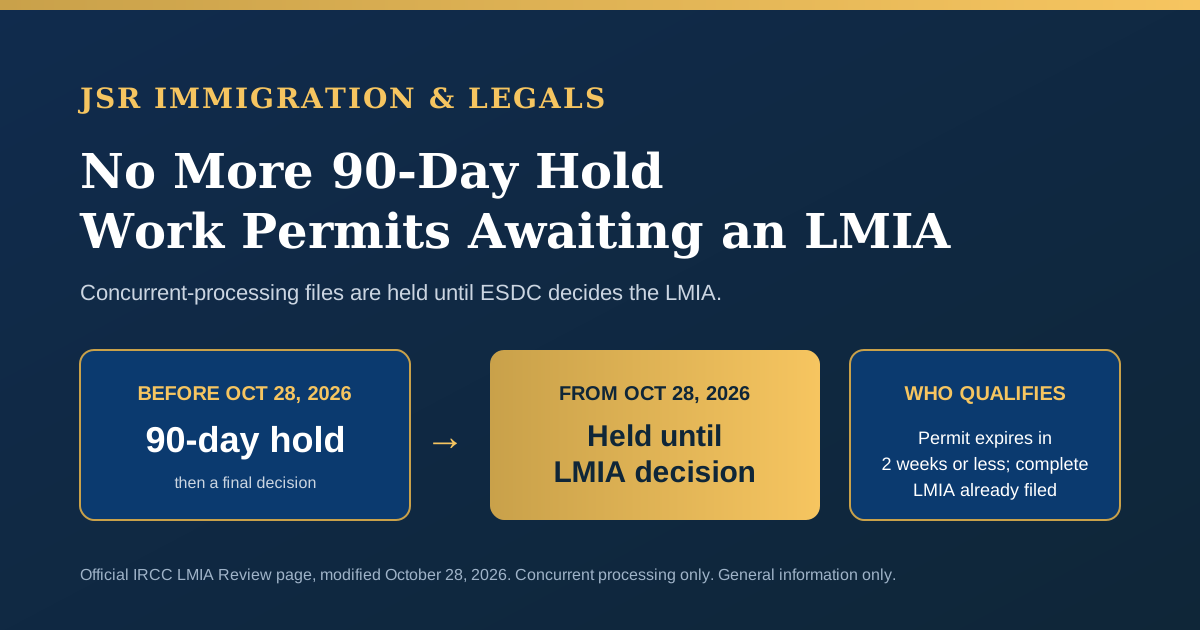
IRCC has changed how officers handle in-Canada work permit applications that are waiting for an employer's Labour Market Impact Assessment (LMIA). On its Labour Market Impact Assessment Review – Temporary Foreign Worker Program page, page details October 28, 2026, the department now states that qualifying applications "will be held by IRCC until there is a decision on the LMIA, after which a final determination regarding the work permit will be made."
The previous version of these instructions gave officers a fixed window. An application submitted under concurrent processing was held for a maximum of 90 days while the employer's LMIA was pending. After 90 days, the officer could make a final decision on the work permit, even if ESDC had not finished the LMIA. That fixed window is gone. The department raised it from 60 days to 90 days on August 21, 2026, and has now removed the fixed limit entirely.
This is an administrative processing change. It does not remove the LMIA requirement, and it does not guarantee approval. It changes the date on which a decision can be made: not before the LMIA decision exists.
Who qualifies for concurrent processing
The exception is narrow. IRCC will not decide the work permit until there is an LMIA decision, and a Quebec Acceptance Certificate (CAQ) if required, only if the worker provides proof that:
- their permit expires in 2 weeks or less
- their prospective employer has submitted a complete LMIA application
- the LMIA was submitted with sufficient lead time, meaning far enough ahead of ESDC's published processing times that a decision could have been made
- no decision has yet been made on that LMIA
IRCC repeats its warning to employers: do not file the LMIA immediately before the worker applies and expect concurrent processing. Such requests are assessed on an exceptional basis.
Applicants who need concurrent processing are asked to follow IRCC's application instructions so that the code CPTS2026 appears in the intended occupation field. The page states the code is for tracking purposes only and the officer's decision should not be affected by whether it appears.
Why the fixed window stopped working
The problem was arithmetic. ESDC's national averages put high-wage LMIA decisions near 90 business days through late summer 2026, as we covered in our September LMIA processing times post. A calendar-day hold of 90 days ran out before the average LMIA arrived.
Under the old rule, the consequence for the worker could be severe. A worker who applied before permit expiry held maintained status, which allows continued work under the conditions of the existing permit. If the 90-day hold expired without an LMIA decision and the application was then refused, that maintained status ended and the worker had to stop working. The refusal came from government processing time, not from anything the worker did.
Under the revised instructions, the file stays on hold until ESDC decides the LMIA. The date that matters is the LMIA decision date, not a fixed clock from the work permit filing date.
What does not change
An LMIA is still mandatory under section R10 for a complete employer-specific application. If ESDC issues a negative LMIA, the work permit application will be refused unless the applicant has another basis for approval. A delayed decision is not an approval: the worker keeps working only under maintained status and the same employer, occupation, and location conditions of the existing permit. The change does not reopen applications already refused.
Employers should still start LMIAs early, measured against ESDC's published times, because the lead-time condition is what unlocks concurrent processing in the first place. If you are timing an extension against an expiry date, read our work permit extension processing post for the IRCC side of the clock.
If your permit expires soon and your employer's LMIA is still pending, contact JSR Immigration & Legals through the consultation page or the work permit service page.
This article is general information current to October 30, 2026, and is not legal or immigration advice. Confirm the live instructions on Canada.ca before you rely on them.

Immigration & paralegal practitioner at JSR Immigration & Legals, helping newcomers and Ontario residents with their cases.
This post is general information about Canadian immigration and Ontario paralegal matters and is not legal advice. Rules change and every case is different — confirm current requirements for your own situation.