Federal Court Pauses Every Bill C-12 Refugee Challenge: The August 20, 2026 Special Order Explained
If you filed a Federal Court challenge to Bill C-12's refugee-eligibility rules, your file is now on hold — and one deadline may still be running.
On August 20, 2026, Chief Justice Alan S. Diner issued a Practice Direction and Special Order on constitutional challenges to sections 101(1)(b.1) and 101(1)(b.2) of the Immigration and Refugee Protection Act, now listed on the Court's notices page. It groups every challenge to those two provisions and freezes their timelines.
What the Special Order does
The Court says it received a high number of applications for leave and judicial review raising substantially similar constitutional issues, placing unprecedented pressure on the Court and its Registry. Relying on Rules 3 and 47 of the Federal Courts Rules, it ordered four things:
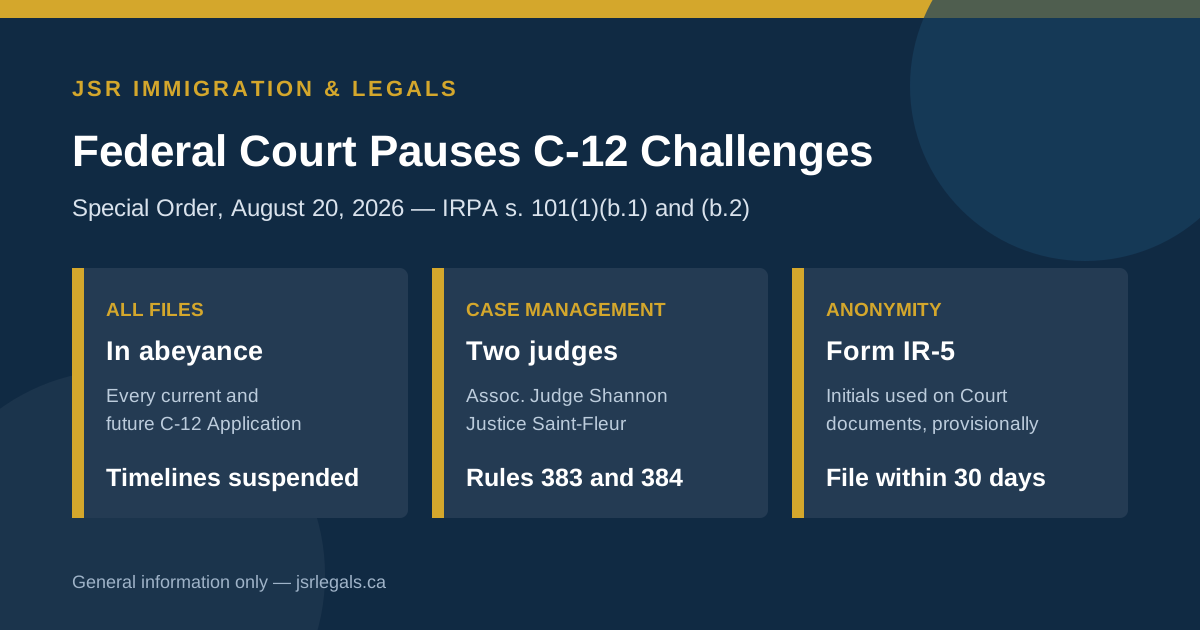
- Group case management. All current and future applications challenging IRPA s. 101(1)(b.1) and/or s. 101(1)(b.2) — the Order calls them "C-12 Applications" — continue as specially managed proceedings under Rule 384.
- Two named judges. Associate Judge Kirkland G. Shannon and Justice Love Saint-Fleur are assigned as Case Management Judges under Rule 383. Other judges may still decide motions.
- Everything is paused. All C-12 Applications are placed in abeyance, with all timelines suspended, pending a further Order or Direction from a Case Management Judge.
- A route to anonymity. Any applicant may request an anonymity order by filing Form IR-5.
The Registry must place a copy of the Order in every C-12 Application file and give a copy to each applicant on filing. Do not wait for the mail to start counting days.
The two provisions under challenge
Bill C-12, the Strengthening Canada's Immigration System and Borders Act, added both paragraphs to IRPA. Each makes a refugee claim ineligible to be referred to the Refugee Protection Division:
- Section 101(1)(b.1) — the "one-year rule": ineligible if the claimant entered Canada after June 24, 2020 and claimed more than one year after entry. Under s. 101(1.1), where there were several entries after that date, the clock starts the day after the first one.
- Section 101(1)(b.2) — the irregular land-border rule, for a claimant who entered along the Canada–United States land border at a place that is not a port of entry and claimed after the time limit in s. 159.4(1.1) of the Regulations — the 14-day window tied to the Safe Third Country Agreement.
We covered the wider package at Royal Assent in Bill C-12 Is Now Law. The Order changes neither provision — only how the Court handles the challenges.
The 30-day anonymity window is the live deadline
Rule 8.1 of the Federal Courts Citizenship, Immigration and Refugee Protection Rules lets a party ask, in Form IR-5, that public Court-prepared documents be redacted enough to keep their identity anonymous. Under the Special Order:
- Once the Registry receives a Form IR-5, and pending the leave decision, it provisionally anonymizes documents the Court prepares from then on, using the applicant's initials.
- Applicants already before the Court have 30 days from the date of the Order to file Form IR-5. If they do not, no anonymity order will be provisionally applied to their file.
Thirty days from August 20, 2026 lands on Saturday, September 19, 2026. Federal Court time computation can push a deadline falling on a Saturday, Sunday, or holiday to the next available day, so the practical last date may be the following business day. Confirm it and file early.
The provisional step is administrative. The anonymity request itself is decided with the leave application, on the same materials, after the Court weighs the public interest in open proceedings — so provisional initials are not a guaranteed permanent order.
What an abeyance does — and does not — mean
An abeyance is a procedural pause, not a decision on the merits. Nobody has won or lost. The Court's stated aim is the just, most expeditious and least expensive determination of these proceedings. Three cautions follow:
- The pause covers the C-12 Applications. It suspends timelines in those proceedings. It does not purport to suspend deadlines in other Federal Court files or in IRCC and CBSA processes.
- "Future" means future. Anyone filing a new C-12 Application is swept in automatically and receives a copy of the Order.
- Watch for directions. The Court encourages parties and counsel to review the Special Order and monitor further directions from the Case Management Judges. That is where the next real deadlines come from.
If you are affected
If you already filed: confirm your file is treated as a C-12 Application, file Form IR-5 in time if you want provisional anonymity, and keep your address for service current. If you have not filed and think either paragraph applies to your claim, get an assessment now — including whether a Pre-Removal Risk Assessment is in play.
Contact JSR Immigration & Legals for help preparing a Form IR-5, monitoring your Federal Court file for new directions, or reviewing how the s. 101 eligibility rules affect a refugee claim. You can also read about our refugee and asylum and immigration appeals services.
This is general information about a Federal Court order, not legal advice for anyone's specific case. Court deadlines are strict — confirm dates with the Registry or a licensed representative.

Immigration & paralegal practitioner at JSR Immigration & Legals, helping newcomers and Ontario residents with their cases.
This post is general information about Canadian immigration and Ontario paralegal matters and is not legal advice. Rules change and every case is different — confirm current requirements for your own situation.