Low-Wage LMIA Extended to Two Years: Canada's November 6, 2026 TFW Program Changes
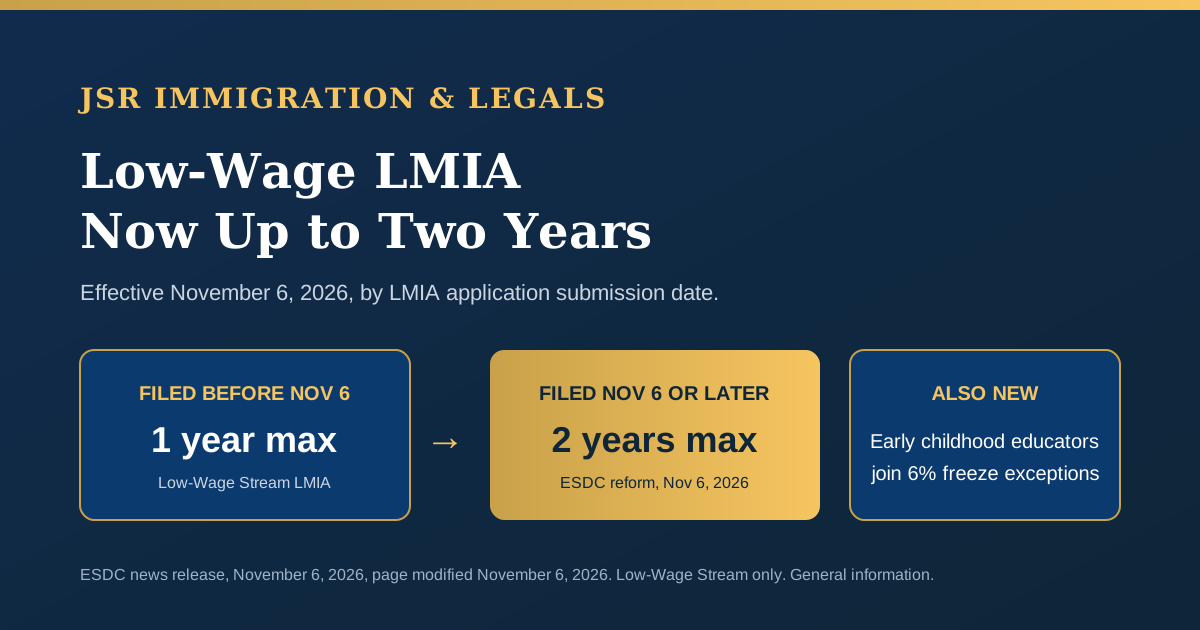
Employment and Social Development Canada (ESDC) announced targeted reforms to the Temporary Foreign Worker (TFW) Program on November 6, 2026. In its news release, last modified November 6, 2026, the department confirmed two changes to the Low-Wage Stream that took effect the same day. Labour Market Impact Assessment (LMIA) applications submitted on or after November 6, 2026 can now be issued for a maximum duration of up to two years, an increase from the previous one-year limit. Early childhood educators were also added to the list of exceptions that allow LMIA processing in census metropolitan areas (CMAs) with an unemployment rate of 6 percent or higher.
The date that matters is the submission date of the LMIA application, not the worker's start date. An application filed before November 6, 2026 keeps the one-year maximum even if the worker arrives months later. An application filed on or after November 6, 2026 can support a two-year position.
What changed on November 6, 2026
Two changes are now in force:
- Two-year maximum duration. Low-Wage Stream LMIA applications submitted on or after November 6, 2026 may be issued for up to two years. Previously the maximum was one year.
- Early childhood educators added to the freeze exceptions. ESDC does not process LMIA applications in CMAs with an unemployment rate of 6 percent or higher, with exceptions for priority sectors: healthcare, construction, and food processing. Early childhood educators are now on that exception list.
What did not change
The rest of the Low-Wage Stream framework is intact:
- The 6 percent unemployment freeze still applies in affected CMAs for occupations outside the exception list.
- The 10 percent cap on a workforce employed through the Low-Wage Stream still applies. A proposed increase to 15 percent is discussed below, but it is not law yet.
- Priority sectors continue to operate under the existing 20 percent limit.
- Employer compliance rules are unchanged. ESDC's release notes that employers who do not respect program requirements face administrative monetary penalties of up to $1 million per year and temporary or permanent bans from the program.
How the filing date decides the duration
The March 1, 2027 proposals
The release also sets out changes that depend on provinces and territories opting in, with implementation proposed for March 1, 2027:
- In CMAs with an unemployment rate of 6 percent or higher, applications will continue not to be processed, except for priority sectors.
- In large CMAs, population over 250,000, with unemployment below 6 percent, employers would have targeted access for occupations outlined in the Canadian Occupational Projection System (COPS), plus any additional occupations identified by provinces and territories.
- In rural areas of large CMAs and in smaller CMAs, population 100,000 to 250,000, the same targeted COPS access would apply.
- In rural communities, employers would keep full access to all occupations in the Low-Wage Stream.
- Provinces and territories that opt in could allow eligible employers in communities they identify to hire up to 15 percent of their workforce through the Low-Wage Stream, up from 10 percent. Priority sectors would stay at 20 percent.
These are proposals contingent on provincial and territorial agreement. They are not in force today, and the details may change before March 1, 2027.
The funding behind the reform
Budget 2026 provides $151.5 million over five years to support and enhance TFW Program service delivery, and $82 million over four years for the Migrant Worker Support Program, which helps temporary foreign workers understand and exercise their rights while in Canada.
What this means for employers and workers
For employers, a two-year LMIA reduces the renewal cycle: one application can now support a longer placement, with fewer repeat LMIA fees and processing gaps. For workers, a longer LMIA can mean a longer work permit and a more stable period of Canadian work experience, which matters for later permanent residence options, including employer-driven provincial pathways covered on our Provincial Nominee Program service page.
Plan around the submission date. If your file was ready in early November, refiling after November 6, 2026 may secure the two-year duration, but weigh that against job start dates and any work permit expiry. We previously covered IRCC's removal of the 90-day hold limit on LMIA-linked work permit applications here.
If your business is hiring through the Temporary Foreign Worker Program, or you are a worker assessing your status and next steps, contact JSR Immigration & Legals through our consultation page or the work permit service page.
This article is general information current to November 8, 2026, and is not legal or immigration advice. Confirm the live ESDC and IRCC pages before you file.

Immigration & paralegal practitioner at JSR Immigration & Legals, helping newcomers and Ontario residents with their cases.
This post is general information about Canadian immigration and Ontario paralegal matters and is not legal advice. Rules change and every case is different — confirm current requirements for your own situation.