Accident Benefit Denied? Ontario Court Confirms the Two-Year LAT Clock Matters
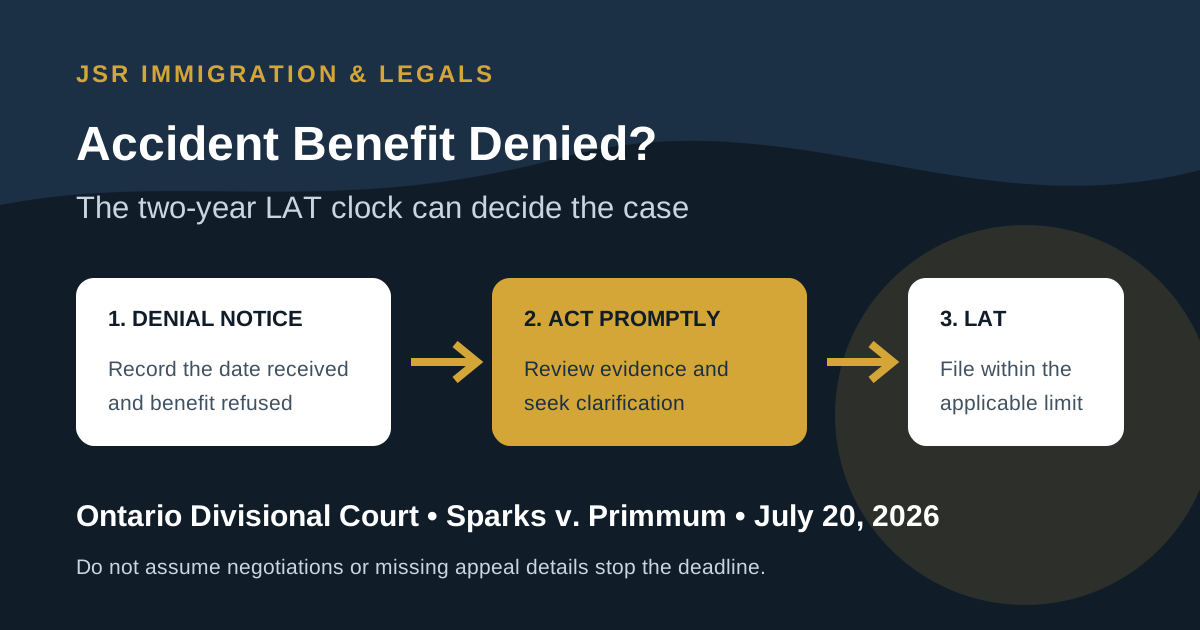
An Ontario court decision released on July 20, 2026, is a warning for anyone disputing an auto insurer's refusal to pay statutory accident benefits: read the denial letter promptly and do not assume the insurer must explain every possible appeal step before the limitation clock can run.
In Sparks v. Primmum Insurance Company, 2026 ONSC 3803, the Divisional Court upheld the Licence Appeal Tribunal (LAT) result. The court concluded that the notice in that case sufficiently explained the right to dispute the refusal and the applicable two-year limit. The appeal and judicial review application were dismissed.
The decision does not make every denial letter automatically valid. It does show why waiting can be dangerous when a letter clearly refuses a benefit and warns of a deadline.
What the court decided
Ontario's Statutory Accident Benefits Schedule requires an insurer that refuses a benefit to give written notice of the refusal and the right to dispute it. In Sparks, the claimant argued that the insurer's notice should have provided more detail about later steps, including reconsideration, appeal and judicial review.
The Divisional Court did not accept that broader reading. Its published recent-decisions summary says the statutory “right to dispute” referred to applying to the LAT under the Insurance Act. The notice did not have to list every possible route after a LAT decision, with all related timelines and court contacts.
The court also rejected the argument that the prominent two-year warning was misleading because it did not explain discoverability or the LAT's possible power to extend time. On the facts before it, the notice was sufficient to require timely action, and the application was out of time.
The practical deadline
Tribunals Ontario's LAT-AABS guide states that a person injured in a motor vehicle accident may apply to the LAT when they disagree with an insurer about entitlement to statutory accident benefits or the amount payable. It also states that an application generally must be filed within two years after receiving the insurer's denial notice.
and the insurer's reasons] C --> D[Gather policy, medical records
and claim documents] D --> E{Can the dispute be resolved
with the insurer?} E -->|Yes| F[Confirm the resolution in writing] E -->|No| G[Consider a LAT-AABS application] G --> H[File before the applicable deadline] H --> I[Case conference and hearing process]
Tribunals Ontario notes that the LAT can sometimes extend the time limit, but an extension is not guaranteed. Negotiating with the insurer also should not be treated as automatically stopping the clock. Anyone approaching two years should obtain advice quickly rather than rely on an assumed exception.
What to check in a denial letter
Start with the basics. Record when and how you received the notice. Identify the exact benefit that was refused or stopped, the effective date, the insurer's reasons and any deadline language. Keep the letter, envelope, email and attachments together.
Then compare the refusal with your policy and claim documents. Accident-benefit rules can depend on the date of the accident, the coverage purchased and the benefit in dispute. Ontario changed parts of its accident-benefit system effective July 1, 2026, so a current policy may not match an older one.
Ask the insurer for clarification in writing if the decision or reasons are unclear. You may provide records that address the stated reason and try to resolve the disagreement before filing. However, keep an independent calendar of the potential LAT deadline while discussions continue.
What the decision does not say
Sparks does not mean wording defects never matter, that every refusal starts the clock in every case, or that late applications can never proceed. Limitation questions depend on the governing law, the contents of the notice and the facts. The court's point was narrower: the notice in this case was sufficient even though it did not teach the claimant every later review and court procedure.
That distinction matters. A denial letter should be assessed, not ignored. Acting early leaves time to request the claim file, collect medical or income evidence, identify the disputed benefits and decide whether a LAT application is appropriate.
JSR Immigration & Legals can help you understand the next procedural steps when an Ontario accident-benefit claim is denied. Contact us before the deadline becomes the central issue in the dispute.
This article provides general information only and is not legal advice. Deadlines and available remedies depend on the specific notice, policy, accident date and facts of the case.

Immigration & paralegal practitioner at JSR Immigration & Legals, helping newcomers and Ontario residents with their cases.
This post is general information about Canadian immigration and Ontario paralegal matters and is not legal advice. Rules change and every case is different — confirm current requirements for your own situation.