Provinces Have Until March 31, 2027 to Nominate 100,000 Workers for PR
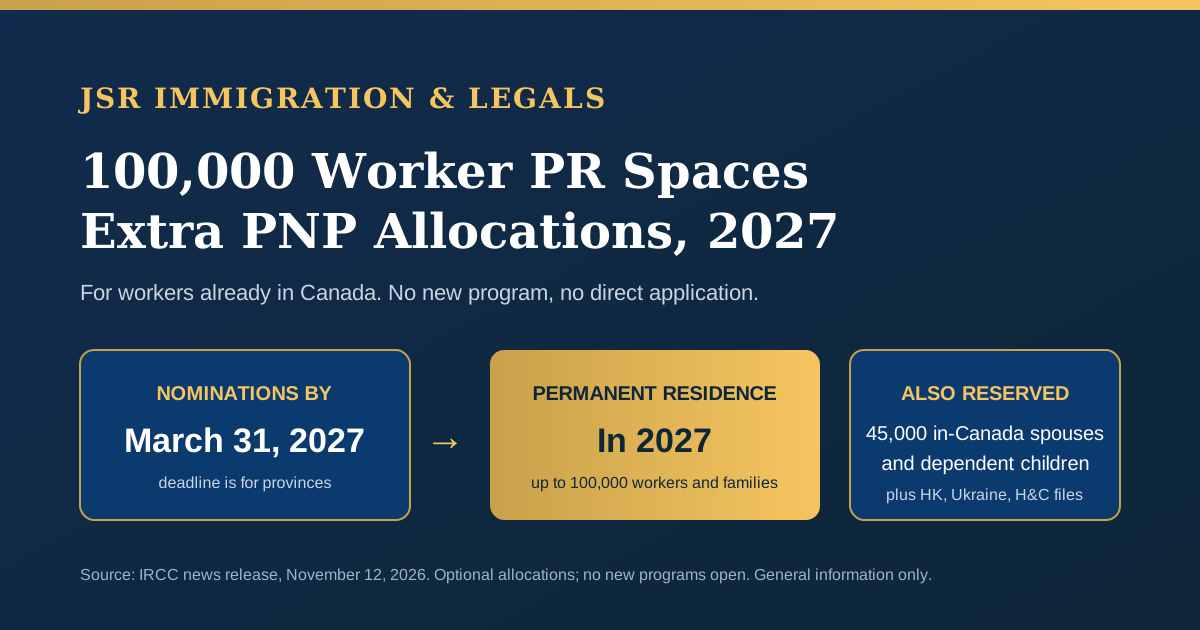
IRCC has added the first hard date to the one-time permanent residence measure announced in Budget 2026. In a news release dated November 12, 2026, Minister Lena Metlege Diab confirmed that provinces and territories will be offered additional Provincial Nominee Program (PNP) allocations to transition up to a combined 100,000 workers and their families to permanent residence in 2027, and that these allocations are intended to be used by March 31, 2027.
The allocations are optional. Each province and territory decides how much of the additional space it uses. A province can nominate workers established in its own communities, and it can also identify workers in its jurisdiction who have already applied for permanent residence under federal programs and are waiting on a decision.
Which federal files provinces can flag
Provincial and territorial governments will be able to identify workers with applications already in the inventory under:
- the Atlantic Immigration Program
- federal programs and pilots that are closed to new applications, including the Start-up Visa Program, the Self-Employed Persons Program, the Agri-Food Pilot and the home care worker programs
If your file sits in one of those queues, this measure may create room for a province to pick it up and a decision to land in 2027. No one can apply to the measure directly.
The rest of the 200,000 spaces now has numbers
The same release puts figures on the other groups IRCC will help transition to permanent residence under the time-limited measure:
| Group | Spaces |
|---|---|
| Workers and families, via extra PNP allocations | Up to 100,000 combined |
| Spouses, common-law partners and dependent children of Canadians and permanent residents living in Canada | Up to 45,000 |
| Hong Kong permanent residence pathway applicants (closed August 2026) | Up to 32,000 |
| Ukraine Family Reunification Pathway applicants (closed October 2024) | Up to 18,800 |
| People already found eligible on humanitarian and compassionate grounds | Up to 12,600 |
IRCC repeats the two boundaries that matter. The measure does not create new programs or re-open closed pathways. Applicants do not need to do anything or contact IRCC for their applications to be processed under these additional spaces. It is also separate from the In-Canada Worker Initiative announced in Budget 2025.
Deadline versus admissions year
Two dates are doing different jobs, and confusing them leads to bad decisions.
The March 31, 2027 date is for the provinces and territories, not for applicants. It is the window for using the extra PNP allocations to nominate workers. The 2027 date is the admissions year: the permanent residence itself is finalized within 2027. An applicant does not file anything by March 31. A nomination issued under the extra allocations is meant to become permanent residence inside the same year.
What this means for you
If you are a worker in Canada with strong ties to your province, the practical effect is that your province's nominee streams now carry extra space aimed at people already working locally. Ontario's streams are on our Ontario PNP page, and the national picture is on the PNP page. Watch your province's stream notices for how it chooses to use the extra allocations.
If you are waiting on a Start-up Visa, Self-Employed, Agri-Food, home care or Atlantic Immigration Program file, keep it decision-ready. IRCC says provinces will be able to identify those existing applications, so respond to document requests promptly and keep your contact details current. See our work permit and permanent residence pages.
If you applied under a closed pathway, such as the Hong Kong pathways or the Ukraine Family Reunification Pathway, the release puts a number on the space reserved to finish those inventories. We covered those backlogs in our Hong Kong and Ukraine post.
If you were hoping for a new application stream, there is none. Nobody can sign up for this measure, and no one should pay a representative to access it.
We covered the overall 200,000 one-time measure in our November 9 post. Use that post for the cohort structure. Use this one for the nomination deadline and the confirmed figures.
To assess how the extra allocations may affect a nomination strategy or a file already in process, contact JSR Immigration & Legals through our consultation page or the PNP service page.
This article is general information current to November 14, 2026, and is not legal or immigration advice. Confirm the live IRCC news release and program pages before you act.

Immigration & paralegal practitioner at JSR Immigration & Legals, helping newcomers and Ontario residents with their cases.
This post is general information about Canadian immigration and Ontario paralegal matters and is not legal advice. Rules change and every case is different — confirm current requirements for your own situation.