November 4, 2026: Rural Community Immigration Becomes a Permanent Class
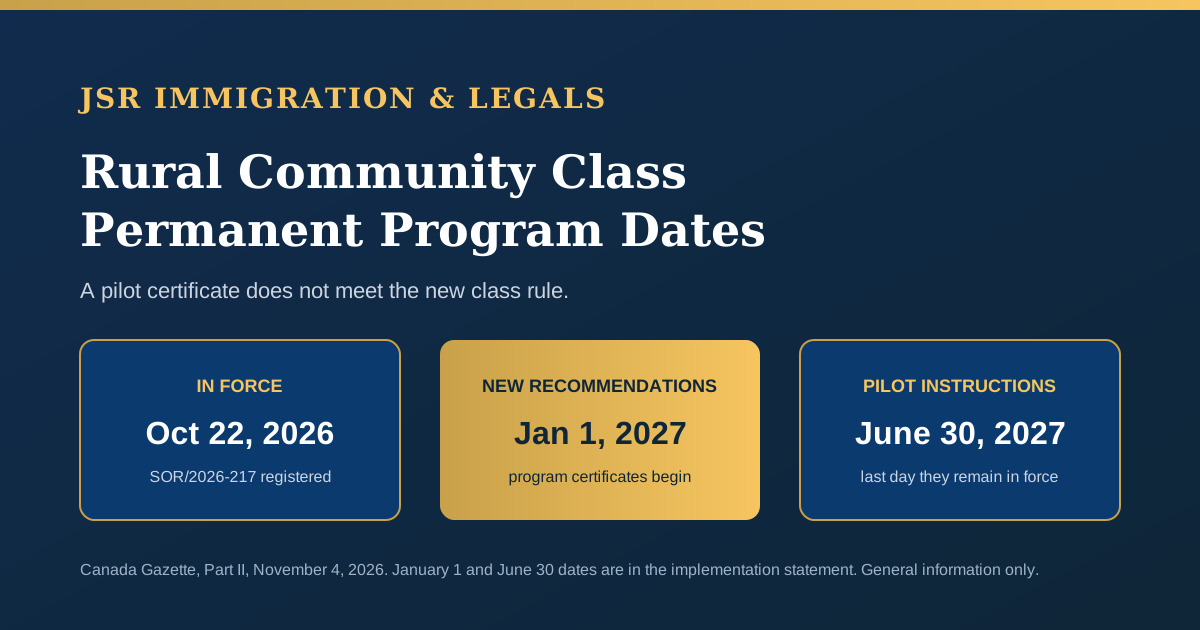
Canada now has a permanent legal class for rural community immigration. On November 4, 2026, the Canada Gazette, Part II, published SOR/2026-217. The order was registered on October 22, 2026 as P.C. 2026-1001. Section 6 brings the regulations into force on the registration day, so the rural community immigration class has been in force since October 22.
The Regulatory Impact Analysis Statement, which says it is not part of the regulations, sets the handoff from the Rural Community Immigration Pilot.
IRCC's Rural Community Immigration Pilot page, date modified April 30, 2026, still shows the pilot as Open. Use the Gazette for the class now in force, and that page for the pilot steps IRCC is still publishing.
Which date controls your file
| Date | What the Gazette says |
|---|---|
| October 22, 2026 | SOR/2026-217 is registered and in force. |
| November 4, 2026 | The text is published in Part II. |
| December 31, 2026 | Last day to finalize existing pilot recommendations. Implementation statement. |
| January 1, 2027 | Communities may begin issuing program recommendations. Implementation statement. |
| June 30, 2027 | Pilot ministerial instructions remain in force for people recommended under them. Tied to the six-month validity of a pilot recommendation. |
Section 5 is the filing rule. A certificate under section 4 of the Ministerial Instructions with Respect to the Rural Community Immigration Class, published in the Canada Gazette, Part I, on December 14, 2024, cannot satisfy paragraph 87.4(2)(b). A pilot certificate supports an application under those instructions. A permanent-class file needs its own certificate. That certificate lasts until the earlier of its first anniversary and revocation.
What you must show
From the permanent residence application until you obtain status, you need a valid certificate, intent to reside in the designated community, an eligible offer, and the work experience below or an exemption. Education is a Canadian credential, or a foreign credential at least equal to a Canadian secondary school diploma, assessed less than five years before you apply. Language results must be less than two years old and meet the published four-skill threshold. In Canada, you need valid temporary resident status.
Unless you are authorized to work and already working in Canada on the application date, you show transferable, debt-free funds equal to one half of the rural low-income cut-off for you and your family members, whether or not they accompany you. The regulation cites Statistics Canada's publication and prints no dollar amount.
Work experience is at least one year full-time, or the part-time equivalent, in the three years before you apply. If you have not applied, the organization uses the day it expects you will apply. The work must include the lead statement and a substantial number of the main duties. Self-employment counts only for a medical practitioner entitled to practise where the work was done. Canadian work requires authorization and temporary resident status.
| Job offer | Work experience that qualifies |
|---|---|
| TEER 0 or 1 | TEER 0, 1, 2, or 3 |
| TEER 2 | TEER 1, 2, 3, or 4 |
| Other TEER 3 or 4 | TEER 2, 3, or 4 |
| NOC 33102 or 44101 | NOC 31301, or TEER 2, 3, or 4 |
| TEER 5 | The same five-digit NOC |
An eligible offer is non-seasonal, full-time, and indeterminate, with at least 75% of the hours in the community. For the certificate, the wage must be at least the highest of the minimum wage, the lowest Job Bank wage, and any higher wage the community sets. The offer must also sit within or above the Job Bank range. The employer must already be designated. The organization must not charge a fee to designate an employer or to issue, amend, or revoke a certificate.
A child's age locks when the certificate application is made, which can be before the permanent residence filing.
A public post-secondary graduate in the community can skip work experience after full-time study with status for the whole program, if the credential is less than 18 months old. A program of at least two years needs 16 months in the community during the prior 24 months. A shorter master's or doctoral program needs presence throughout. Language study or distance learning above half the credits, or a scholarship that requires a return home, does not qualify.
What this means for you
If you hold a pilot recommendation, file under the ministerial instructions through June 30, 2027. If you want a new recommendation, use the January 1, 2027 program track in the table above.
If you are an employer, you need a genuine priority-sector business, intercultural and onboarding training, and settlement support. Qualify with two years under the same ownership in the community, or with a substantial contribution, in the organization's opinion, by staying or relocating. A business that recruits only to supply other businesses cannot be designated.
The statement lists 14 pilot communities, including North Bay, Sault Ste. Marie, Sudbury, Thunder Bay, and Timmins. The Minister may designate other rural communities outside Quebec. The Francophone Community Immigration Pilot remains separate.
To match a job offer to this class, or to compare it with an Ontario nomination, contact JSR Immigration & Legals through our consultation page, the rural pilots page, or the Ontario PNP page.
This article is general information current to November 5, 2026, and is not legal or immigration advice. Confirm SOR/2026-217 and the IRCC rural community pages before you act.

Immigration & paralegal practitioner at JSR Immigration & Legals, helping newcomers and Ontario residents with their cases.
This post is general information about Canadian immigration and Ontario paralegal matters and is not legal advice. Rules change and every case is different — confirm current requirements for your own situation.