IRCC Spells Out the Super Visa Income Rules: What the August 25, 2026 Officer Instructions Say
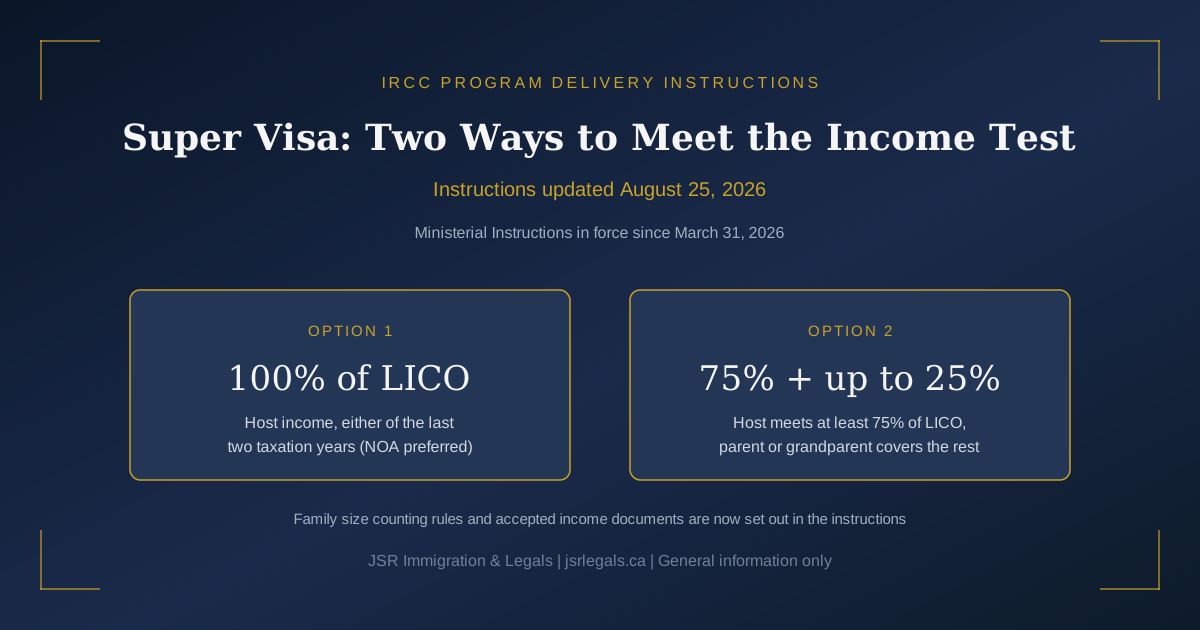
When IRCC changed the parent and grandparent super visa income rules in March 2026, families were told there would be two ways to meet the minimum necessary income, but the announcement was short on detail. On August 25, 2026, IRCC updated its program delivery instructions for the super visa, the guidance officers apply when they assess a file.
Nothing about the underlying Ministerial Instructions changed. They were issued under subsection 15(4) of the Immigration and Refugee Protection Act and took effect on March 31, 2026. What changed is how much of the assessment is now spelled out in public: the exact percentages, the income periods, the documents an officer may accept, and who has to be counted in your family size.
Option 1: your better year out of the last two
Under the first option, the host — and the co-signing spouse or common-law partner, if there is one — shows that their total income in either of the two taxation years immediately before the application was submitted meets or exceeds the most recent low income cut-off (LICO) for the applicable family size.
IRCC's preferred proof is the Canada Revenue Agency Notice of Assessment. Where an NOA is unavailable, or does not capture all of the income for that taxation year, officers may also consider the host's T4 or T1.
Option 2: at least 75% from the host, up to 25% from your parent
The second option is the one that opens the program to more families. The host and co-signer show income meeting at least 75% of the most recent LICO, measured over either the most recent taxation year or the most recent 12-month period before the application was submitted. The visiting parent's or grandparent's own income can then be used to cover the remainder, up to a maximum of 25% of LICO.
Two practical points follow. If a host invites both parents or both grandparents at once, the income of both applicants may be counted toward the shortfall. And a host who simply prefers to rely on a recent 12-month stretch of earnings, rather than a filed tax year, may choose Option 2 for that reason alone.
IRCC's own worked example
The instructions include sample calculations that show the arithmetic officers expect. In one example, a host with a spouse and two dependent children invites two parents in June 2026, giving a family size of six. IRCC uses $72,560 as the most recent LICO for six persons in May 2026, so the host must show at least $54,420 — the 75% figure — and the applicants make up the difference. The instructions also chart the sliding scale: at 80% the host shows $58,048 and the applicants $14,512; at 90% it is $65,304 and $7,256.
These are IRCC's illustrations for a specific month, not a fixed threshold. LICO amounts are set by Statistics Canada and updated annually, so confirm the current figure for your own family size first.
Who has to be counted in your family size
This is where applications quietly go wrong, and the updated guidance is unusually specific. The count includes the host, the host's spouse or common-law partner (which may include a separated spouse), and dependent children of both — including dependent children of dependent children, regardless of custody or child support arrangements.
It also reaches backwards. You must count previously approved super visa applicants the host or their spouse signed or co-signed an invitation for, where that visa is still valid, and previously sponsored individuals whose undertaking is still in effect, plus their family members whether or not they were named in it.
Because the super visa is a temporary resident visa, the applicant's own family members are not added to the count. That differs from family class sponsorship, and it is a common source of confusion.
Documents: file more than one
For host income proved outside an NOA, the instructions list pay stubs, an original employer letter stating job title, job description and salary, bank statements, and proof of other income such as pension statements. For the visiting parent or grandparent, IRCC sets out acceptable documents by source: pension, remote employment, investment or business income, and rental or leasing income.
Evidence should cover a 12-month period, and IRCC states plainly that applicants should generally submit multiple documents, because that raises the officer's confidence that LICO is met on a balance of probabilities. Foreign income is converted to Canadian dollars using the rate in effect on the date the application was submitted.
What did not change
The rest of the program is unchanged. The super visa remains a multiple-entry temporary resident visa valid for up to 10 years, allowing a stay of five years per entry. Applicants must apply from outside Canada, complete an immigration medical exam, and hold health insurance valid for at least one year from the date of entry with a minimum of $100,000 in emergency coverage — paid in full or by instalment with a deposit, since quotes are not accepted.
If you are preparing a super visa application, or a previous refusal turned on the income calculation, contact JSR Immigration & Legals through our consultation page to review which option fits your household.
This article is general information current to August 30, 2026, and is not legal or immigration advice. Income thresholds and instructions change; always confirm the current requirements on Canada.ca before filing.

Immigration & paralegal practitioner at JSR Immigration & Legals, helping newcomers and Ontario residents with their cases.
This post is general information about Canadian immigration and Ontario paralegal matters and is not legal advice. Rules change and every case is different — confirm current requirements for your own situation.