Gift or Trust? Ontario Court of Appeal Orders New Trial Over $30 Million in Caregiver Transfers
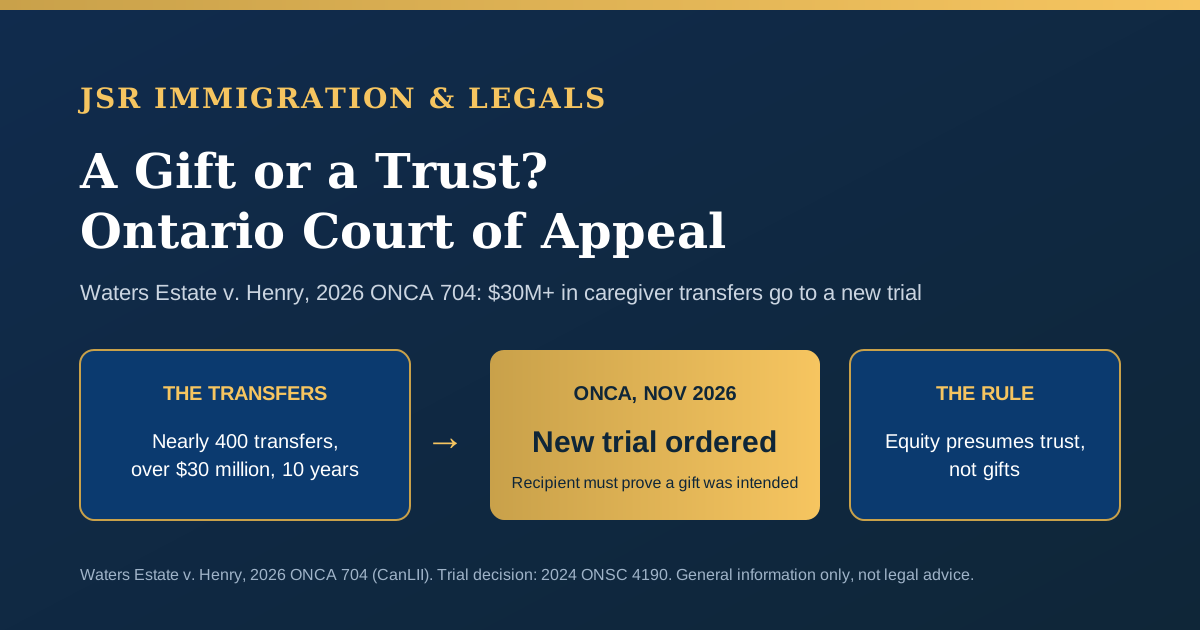
When an older Ontarian transfers large sums of money to a caregiver, a friend or a family member, and dies before anyone asks the question, Canadian equity has a default answer: equity presumes bargains, not gifts. The recipient is presumed to hold the money in trust for the person who gave it, and it is the recipient who must prove a real gift was intended. In mid-November 2026, the Court of Appeal for Ontario applied that rule to one of the largest estates cases the province has seen, in Waters Estate v. Henry, 2026 ONCA 704, and ordered a new trial over more than $30 million transferred to a personal care worker. The decision is a reminder, useful to any family, of who carries the burden when money moves without paperwork.
What happened
The deceased was a wealthy Ontario businessman. He hired a personal care worker to help care for his disabled wife, and over roughly a decade he made nearly 400 transfers to that worker, valued at more than $30 million in total. The worker used the funds to buy nearly two dozen properties and to fund what the court heard described as a luxury lifestyle. Some of the money did not even belong to him: he managed his wife's finances under a power of attorney, and some of her funds were transferred too.
After his death, his estate sued for the return of the funds and the properties, arguing the transfers were investments. The personal care worker replied that they were gifts. At trial, the Superior Court of Justice found the two had been in a secret intimate relationship and held that the bulk of the transfers and the properties bought with them were gifts, in Waters v. Henry, 2024 ONSC 4190. The trial judge did, however, order the worker to return the money taken from the wife through the power of attorney. The estate appealed.
What the Court of Appeal decided
A three-judge panel of the Court of Appeal, in a decision released in mid-November 2026 with Justice Pomerance writing, allowed the appeal in part and ordered a new trial on whether the transfers were gifts or held on resulting trust.
The panel's core finding was about the burden of proof. When a person gratuitously transfers property, the presumption of resulting trust applies and the recipient bears the onus of rebutting it by proving, on the balance of probabilities, that a gift was intended at the time of the transfer. The trial judge had effectively reversed that onus by looking for evidence that the deceased intended to keep a beneficial interest in the properties. For most of the transfers, the Court of Appeal found there was "insufficient evidence capable of countering the presumption."
Three practical rulings stand out:
- The absence of loan documents does not necessarily show a gift was intended. In this case some loans were documented and others were not, so silence cut both ways.
- Where there are many transfers over many years, a single uniform intention cannot simply be inferred. The court drew a distinction between transfers used to buy property and transfers used to pay debts and personal expenses.
- An intimate relationship, standing alone, is not enough to rebut the presumption. Under section 13 of Ontario's Evidence Act, an interested party's evidence in estate litigation must be corroborated, and the relationship was only context.
The court also set aside the trial ruling that excluded the deceased's handwritten notes as hearsay, leaving their admissibility and weight for the new trial. Nothing is finally decided: whether the transfers were gifts or held in trust will be determined again.
What this means for you
- If you are the person giving: a transfer without documentation is presumed to be held in trust, not a gift. Documenting your intent at the time, in writing, matters far more than explaining it later.
- If you are the person receiving: keep records. The onus is on you to show a gift was intended when the money moved, not years afterwards in litigation.
- If you hold a power of attorney: money you move for your own benefit from the grantor's accounts may be ordered repaid, as even the trial judge ordered here. A power of attorney is a fiduciary role, and courts treat self-dealing strictly.
- Where a vulnerable person and a paid caregiver are involved, courts will not assume gifts simply because a relationship existed. The corroboration rule in estate disputes means the recipient's own account is not enough.
Estate disputes, powers of attorney and money transferred without paperwork are exactly the situations where early advice changes outcomes. JSR Immigration and Legals can review your situation and explain your options. See our employment law services page and Small Claims Court services page, or contact us at (647) 286-4266 or info@jsrlegals.ca.
This post is general information, not legal advice, as of November 19, 2026. For advice on a specific matter, please contact JSR Legals.
Sources
- Waters Estate v. Henry, 2026 ONCA 704 (CanLII): https://www.canlii.org/en/on/onca/doc/2026/2026onca704/2026onca704.html
- Waters Estate v. Henry, 2024 ONSC 4190 (CanLII): https://www.canlii.org/en/on/onsc/doc/2024/2024onsc4190/2024onsc4190.html
- Hull and Hull LLP, Court of Appeal Clarifies Factors to Consider When Applying the Presumption of Resulting Trust in Waters Estate v Henry, November 2026: https://hullandhull.com/2026/11/court-of-appeal-clarifies-factors-to-consider-when-applying-the-presumption-of-resulting-trust-in-waters-estate-v-henry
- Law360 Canada, Court orders new trial over $30M businessman transferred to lover who cared for his wife, November 16, 2026: https://www.law360.ca/ca/estates/articles/2550733
- Evidence Act, R.S.O. 1990, c. E.23, s. 13 (corroboration in actions by or against heirs): https://www.ontario.ca/laws/statute/90e23
JSR Legals / JSR Immigration Ltd. 9300 Goreway Drive, Suite 205, Brampton, ON L6P 4N1 (647) 286-4266 info@jsrlegals.ca

Immigration & paralegal practitioner at JSR Immigration & Legals, helping newcomers and Ontario residents with their cases.
This post is general information about Canadian immigration and Ontario paralegal matters and is not legal advice. Rules change and every case is different — confirm current requirements for your own situation.